How to Get More Google Reviews as an HVAC Contractor
97% of homeowners read reviews before hiring an HVAC company. Here's how to build the ask system that works — timed to the 3 job types where it converts best.

84% of consumers don't have a specific HVAC company in mind when they start searching online (WebFX / Invoca, 2025). They're picking from whatever shows up — and the thing that tips the decision is reviews.
The trades with the strongest Google presence in NWA aren't always the biggest companies. They're the ones who built a consistent way to collect reviews — and HVAC has better natural opportunities to do that than almost any other trade.
Emergency AC repair on a 100-degree afternoon. New furnace install after the old one quit in January. Spring tune-up where the system checked out clean and the customer got a bill of health. Each of those jobs ends with a homeowner who's relieved, satisfied, or both. Almost none of them leave a review — not because they're unwilling, but because no one asked at the right moment with a clear path to follow through.
This is specifically about HVAC: where the best ask moments are, what to send, and how to handle the review type that shows up most in this trade. For the full picture on how reviews affect Map Pack rankings — star ratings, review velocity, how Google reads the words inside reviews — start with my complete guide to Google reviews for contractors.
Key Takeaways
- 97% of homeowners read reviews before hiring a local business (BrightLocal, 2026)
- Review signals account for ~20% of Google Maps rankings (Whitespark, 2026)
- Emergency repairs, new installs, and seasonal tune-ups each have a distinct ask window — and timing is everything
- Text with a direct link sent the same day converts better than email or in-person asks alone
Why HVAC Contractors Leave Reviews on the Table
74% of HVAC consumers consulted at least one online review site before making an HVAC purchase decision (WebFX, 2025). Review signals account for roughly 20% of Google Maps ranking placement, according to Whitespark's 2026 Local Search Ranking Factors survey — the second-highest factor category, behind only your Google Business Profile setup. Most HVAC companies I've looked at in NWA have fewer than 15 reviews, often from customers who left them without being asked.
The problem isn't reluctant customers. HVAC is one of the few trades where the work creates a clear emotional contrast: the homeowner was uncomfortable or anxious, and now they're not. That resolution is exactly where reviews come from — but the window is short. Wait a week and the relief has faded into routine. The moment is gone.
If your GBP is still the way it was the day you claimed it, that's the faster fix. I cover categories, service areas, and what actually moves the Map Pack in my local SEO guide for HVAC companies.
The 3 HVAC Job Types Where Reviews Convert Best
Not every job is an equal ask opportunity. BrightLocal's 2026 Local Consumer Review Survey found that 83% of consumers will leave a review when asked — the ask itself is the bottleneck, not the willingness. Three HVAC job types consistently create the conditions where customers are most likely to follow through.
Emergency Repairs
When a homeowner's AC fails on a Tuesday in August and you show up the same day and fix it, the emotional contrast is stark — anxious and uncomfortable before you arrived, cool and relieved after you left. That contrast is what gets reviews written.
The ask happens before you pack up. The longer you wait after an emergency call, the more that relief normalizes into background satisfaction. Ask at job close, then send the text before you leave the neighborhood.
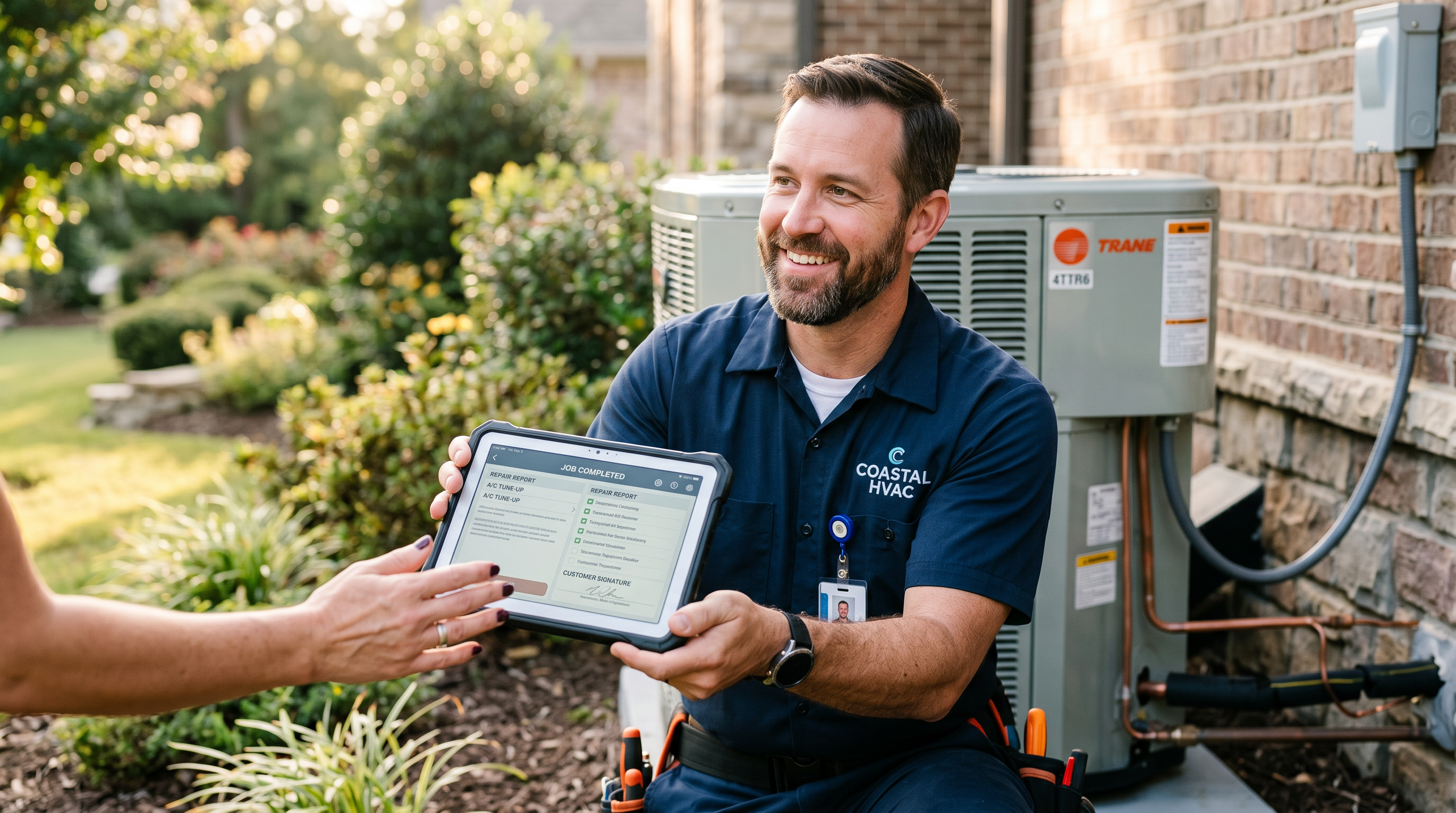
Service completion is the window. Wait too long and the moment is gone.
New System Installs
A new HVAC system is one of the larger purchases a homeowner makes — often $6,000 to $15,000 depending on the system and complexity. If the job went cleanly, the customer watched your crew work and now has a quiet, efficient system running. That's a high-trust, high-satisfaction moment.
Every HVAC GBP I've audited in NWA with fewer than 20 reviews has one thing in common: the installs happened, the customer was satisfied, and nobody sent the text. The ask never came. New installs should generate a review every single time — if they're not, the system isn't there yet.
Seasonal Tune-Ups
Tune-ups are low-drama by design: you showed up, checked the system, and delivered exactly what the customer paid for. No surprises. The interaction ends cleanly and the customer knows the work is done. That's a natural close for a review ask.
The sequence that works best on tune-ups: in-person at job completion, followed by a text with the direct link before you leave. The customer is satisfied, the moment is unambiguous, and there's no tension from a diagnosis or unexpected repair cost.
What to Send, When to Send It, and How to Get the Link
Text outperforms email for HVAC review requests — and the in-person ask works best when it sets up the text, not as a standalone. Email gets buried. In-person feels comfortable but the customer forgets by the time they're home. A text with a direct link sent the same day removes every barrier between a satisfied customer and a posted review.
According to BrightLocal's 2026 Local Consumer Review Survey, 74% of consumers only trust reviews written within the last three months — and 32% want reviews from the last two weeks. Sending the request the same day you complete the job is the single highest-impact change most HVAC companies can make.
Recency also matters for rankings, not just consumer trust. Reviews under 30 days old carry full ranking weight. Reviews older than 180 days retain only 10–20% of that weight (Whitespark, 2026). That's why velocity beats volume — a contractor getting three reviews a month will outrank one who got thirty reviews two years ago and stopped asking.
Here's the full two-step sequence:
Step 1 — In-person close at job completion:
"Glad we got that handled. I'll shoot you a quick text with a link — takes about a minute if you're willing to leave a review."
Step 2 — Text within the hour, before you leave the area:
"Hey [First Name], thanks for letting me take care of that today. If you have a minute, a Google review would really help me out — here's the direct link: [link]"
One sentence. One link. No pressure.
Getting your direct review link: Go to your Google Business Profile, click "Ask for reviews," and copy the link Google provides. Shorten it with Bitly before you start using it — the raw URL is too long for a clean text message.
For a more detailed breakdown — including follow-up timing, what to do when someone doesn't respond, and templates for different job types — I've put the full step-by-step version in my Google review request guide for contractors.
What HVAC Review Text Actually Does for Your Rankings
Google doesn't just count your reviews — it reads them. The specific words customers use in review text feed what Google's AI uses to understand what your business does and where you do it.
According to Whitespark's 2026 Local Search Ranking Factors survey, "Quantity of Native Google Reviews with Text" is the 9th most important Map Pack ranking factor — counted separately from star-only ratings. A review that says "replaced our 15-year-old heat pump in Fayetteville, crew was on time and cleaned up after" tells Google three things: heat pump replacement, Fayetteville, service reliability. That review is more useful for local ranking than ten reviews that say "great service."
You can't write reviews for customers, but you can set up better ones with the way you ask. Instead of "can you leave us a review," try: "If you're willing to mention what we did — even just 'fixed the AC unit' or 'installed a new furnace' — it helps homeowners searching for the same thing find us." Most customers are happy to be specific when they understand why it matters.
Review text with service keywords — "heat pump replacement Fayetteville" — is a Map Pack ranking signal on its own.
How to Handle the Most Common Negative HVAC Review
HVAC is expensive. Homeowners sometimes experience bill shock — especially after emergency repairs where the cost is high and there was no window to get other quotes. The most common negative HVAC review isn't about workmanship. It's about price.
You can't change what a review says. You control the public response — and that response is visible to every homeowner who reads the review afterward. Keep it to two sentences: acknowledge the experience, and invite them to continue the conversation offline.
"I understand the cost of an emergency repair can be a surprise. Please reach out at [phone] and I'll make time to walk through it with you."
No defensiveness. No public breakdown of your rates. The customer who left the review may not change their mind, but the homeowner reading your reply is deciding whether you handle problems well. A measured response to a price complaint often builds more trust than the complaint itself destroys.
Negative reviews are also a sign your GBP profile needs attention. I cover the full picture in my local SEO guide for HVAC companies.
Build the Habit Before the Season Peaks
HVAC gives you more natural review moments than almost any other trade. Emergency calls, installs, tune-ups — each one ends with a customer who's satisfied enough to help you, if you ask at the right time with a clear path to follow through.
The system is simple: get your direct review link, write one text template per job type, and send it the same day the job closes. After ten jobs at that cadence, you'll start seeing the gap close between your review count and your Map Pack competitors.
If you want to see where your current review count and Google Business Profile actually stand, run your free audit and I'll show you exactly what's holding back your local rankings.

Written by
Chad Smith
Founder of Local Search Ally. Helping NWA contractors get found on Google. Based in Siloam Springs, AR.