How to Get More Google Reviews as a Contractor (Without Pestering Customers)
A 5-step system for getting Google reviews consistently — the text to send, when to send it, and what actually converts. Built for NWA home service contractors.

I've talked to a lot of NWA contractors who have been in business for 10, 15, even 20 years. They've got loyal customers, referrals, repeat business. And they have four Google reviews.
It's not because their work is bad. It's because nobody ever built a system to collect them.
I've put together a complete guide on Google reviews for contractors if you want the full strategy picture, but if you're ready to start fixing your review count today, keep reading.
Referrals happen because someone had a good experience and ran into a neighbor who needed the same thing. Reviews work the same way — but only if you make it easy. Most contractors never ask. And the ones who do ask once, get uncomfortable when it feels awkward, and never ask again.
Here's how to build a simple, consistent review system that actually works — and why getting this right matters more in 2026 than it ever has before.
Why Google Reviews Matter More Than You Think
BrightLocal's 2026 Local Consumer Review Survey found that 97% of consumers read reviews when evaluating a local business. That's not a soft preference — it's table stakes. If you don't have reviews, you don't exist in the comparison.
Google reviews directly affect two things that hit your revenue:
How high you rank in Maps. Whitespark's 2026 Local Search Ranking Factors survey — compiled from 47 local SEO experts — ranks "High Numerical Google Ratings" as the 6th most important Map Pack factor. A contractor with 45 reviews at 4.7 stars will almost always outrank one with 200 reviews at 3.8.
Whether someone calls you after they find you. 47% of consumers won't use a business with fewer than 20 reviews — and 31% won't consider anything below 4.5 stars, up from 17% just one year ago. Your customers are applying a harder filter than they were 12 months ago.
Reviews are your reputation made visible. You've spent years building the actual reputation. This is just about making it show up where customers are looking.
The Biggest Mistake: Asking Too Late
Most contractors who do ask for reviews make one consistent mistake — they ask weeks or months after the job is done, when the customer has moved on and the satisfaction of a finished project has faded.
Here's why timing has become critical: 74% of consumers only trust reviews written within the last three months. That number jumped sharply in the past year. A review left six months after the job isn't just less likely to happen — it's also less trusted when it does.
The best time to ask is within 24 hours of completing the job. Ideally the same day, while they're still standing in front of the finished work and feeling good about it.
Think of it like getting a signature on a contract. You wouldn't send the paperwork three weeks after closing the deal. Same principle.
What Google's AI Is Actually Reading in Your Reviews
This is new, and most contractors don't know it yet. I go into the full technical breakdown of this in my Google reviews guide for contractors, but here is the short version.
Google now uses AI to generate review summaries — the short paragraph that appears above individual reviews on your Business Profile. According to BrightLocal's 2026 survey, 82% of consumers read those AI-generated summaries when making a decision. 23% rely on them without reading individual reviews at all.
The AI is pulling themes and service keywords directly from your review text. If your customers write things like "replaced our water heater same day" or "fixed the breaker panel before the home inspection," those details get surfaced to the next person searching for exactly that service. A review that says "great service, would recommend" contributes almost nothing to that summary.
This also shows up in Whitespark's ranking data: "Quantity of Native Google Reviews with Text" is the 9th most important Map Pack factor — scored separately from star-only ratings. Text-based reviews rank. Stars alone don't move the needle the same way.
You don't script reviews — that's a policy violation. But you can frame the ask in a way that makes specific text more likely: "If you have a minute, it would really help if you mentioned what we worked on and how it went." That's it.
Step 1: Get Your Review Link
You need a direct link that takes customers straight to the review box on your Google Business Profile — not to your profile homepage where they have to hunt for the button.
Here's how to get it:
- Search your business name on Google
- Find your Business Profile in the results
- Click "Get more reviews" in your profile management panel
- Copy the link Google gives you
Save that link somewhere easy to access — in your phone's notes, in a text template, on a sticky note in your truck. You'll use it every day.
Step 2: The Text Message Method
The most effective way to ask for a review is a personal text message sent the same day as the job. Not an email. Not a printed card. A text.
Here's a simple message that works:
"Hey [Name], thanks again for letting me take care of that [briefly walkthrough what you did] — really appreciate the business. If you have 2 minutes, a Google review would mean a lot. If you can, mention what we worked on — it really helps. Here's the link: [your review link]. Thanks!"
That's it. No begging, no explaining what a review is, no step-by-step instructions. A direct, personal ask with a link that goes straight to the review box — and a simple nudge to include specifics.
A few things that make this work:
- It's personal (use their name)
- It's timely (same day = still happy)
- It's frictionless (one tap to the review form)
- It doesn't feel like a mass marketing blast
BrightLocal's 2026 data shows that 83% of people leave a review when asked — and 28% now say they "always" write one when asked, up from 16% just a year ago. Most contractors leave this on the table because they never ask consistently.
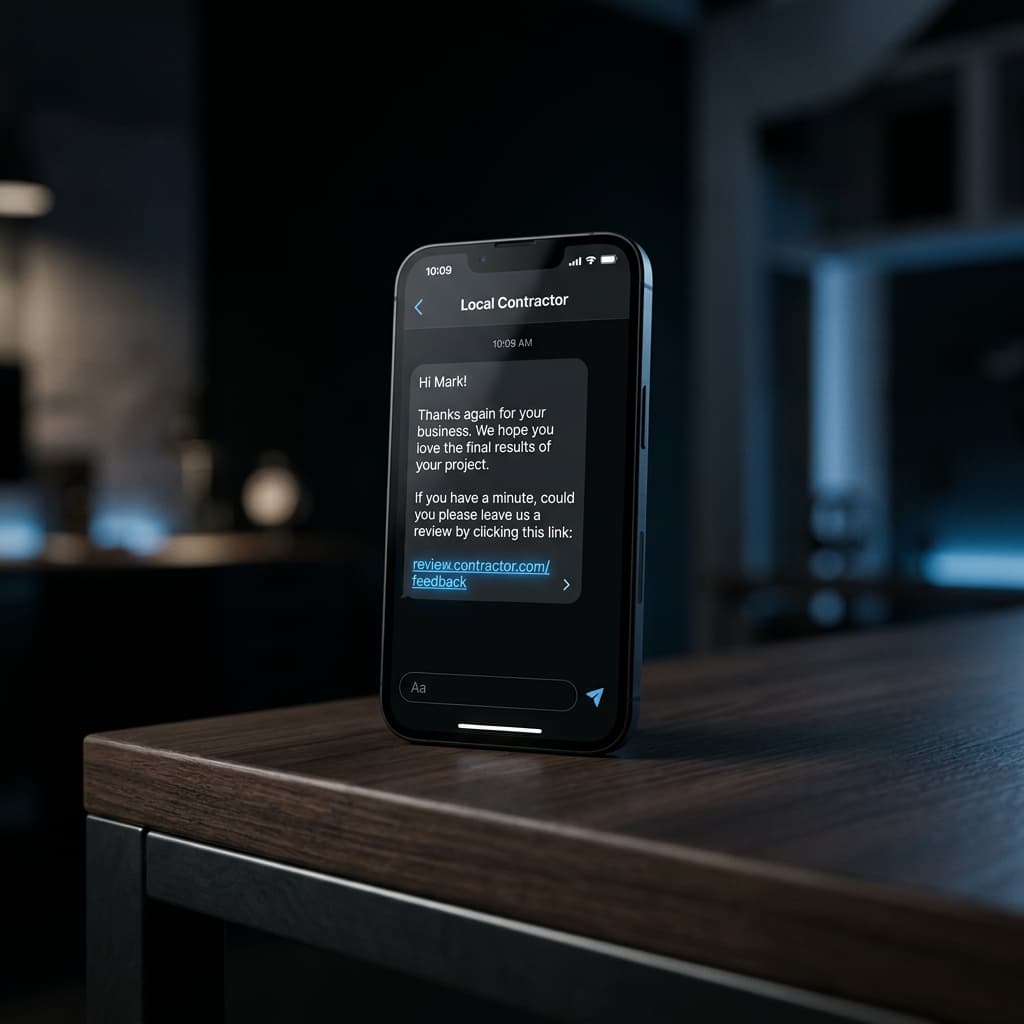 A cinematic mockup of a phone showing the exact text message template shared in the post, highlighting the one-tap shortcut to the Google review box.
Step 3: Build It Into Your Closing Routine
The reason most contractors don't collect reviews consistently isn't that they don't want to — it's that they don't have a trigger to remember.
Make asking for a review part of how every job ends. Right after you collect payment or say your goodbyes, pull out your phone and send the text. It takes 30 seconds.
If you have employees or a crew, brief them on it once, give them the link, and make it a standard closing step — the same way you'd hand someone a business card.
Step 4: Follow Up Once (Just Once)
If someone didn't leave a review after your initial ask, you can follow up one time about a week later. Keep it light:
"Hey [Name], just checking in — hope everything with the [job] is still going great. If you get a chance to leave that Google review, here's the link again: [link]. No pressure at all."
One follow-up is appropriate. Two starts to feel like pestering. Know the difference and respect it.
Step 5: Respond to Every Review — Fast
When someone leaves a review — positive or negative — respond to it. This matters more than most contractors realize.
BrightLocal's 2026 survey found that 80% of consumers are more likely to use a business that responds to all its reviews. And expectations around response time have tightened sharply: 89% of consumers expect a response to their review, and 19% now expect a same-day reply — up from 6% just one year ago.
For positive reviews: Thank them by name, mention the specific job if you can, and keep it genuine. Don't use the same canned response every time — 50% of consumers say templated responses make them less likely to choose that business.
For negative reviews: Stay calm, acknowledge their concern, and offer to make it right offline. Don't get defensive in a public forum. Potential customers read your responses as much as they read the reviews — and a graceful response to a bad review can build more trust than a page full of five-star scores.
If you need to set up or optimize your GBP first, I covered exactly how to do that in this guide.
What to Avoid
Don't offer anything in exchange for reviews. This isn't just Google's policy — since October 2024, it's federal law. The FTC's Final Rule on fake reviews prohibits offering compensation tied to a positive review. Civil penalties apply. A discount in exchange for a "good" review is illegal. A direct ask with no strings attached is not.
Don't buy reviews. Google's AI blocked 240 million policy-violating reviews in 2024 — 41% more than the year before. Suspicious review patterns trigger profile restrictions, and a suspended GBP is far more damaging than a thin review count.
Don't ask for reviews in bulk. A sudden spike after years of silence raises flags. Steady and consistent beats a burst every time.
A Realistic Goal
The first milestone worth targeting is 20 reviews. That's the floor where nearly half of consumers will actually consider you — 47% won't use a business below that number, according to BrightLocal's 2026 data.
 A technical chart showing how review counts compound over time with a consistent system, transforming a small monthly effort into a dominant local reputation.
After that, the goal is consistency. 74% of consumers only trust reviews from the last three months — which means a contractor with 80 old reviews and nothing new in six months is effectively running on empty. The system has to keep running even after you feel like you have "enough."
That's not a complicated marketing strategy. That's just building a process around the work you're already doing.
Frequently Asked Questions
How many Google reviews does a contractor need to rank in the Map Pack?
There's no magic number, but the consumer trust floor has moved. According to BrightLocal's 2026 Local Consumer Review Survey, 47% of consumers won't use a business with fewer than 20 reviews. Getting to 20 is the first milestone — after that, consistent new reviews matter more than the total count.
Is it against Google's rules to ask customers for reviews?
No — asking is completely allowed. What's prohibited is offering anything of value in exchange. Google's platform policy bans incentivized reviews, and since October 2024, the FTC's Final Rule makes buying reviews tied to positive sentiment a federal violation. A direct, honest ask with no strings attached is exactly what you're supposed to do.
What's the best time to ask a customer for a Google review?
The same day the job is done, while the customer is still feeling good about the outcome. BrightLocal's 2026 survey found that 74% of consumers only trust reviews written within the last three months — and recency expectations have tightened significantly year over year. Waiting even a few days reduces both the likelihood of getting a review and its perceived freshness.
Does the text inside a Google review affect your ranking?
Yes — and this matters more than it used to. Whitespark's 2026 Local Search Ranking Factors survey found that "Quantity of Native Google Reviews with Text" is the 9th most important Map Pack ranking factor, scored separately from star-only ratings. Google's AI also extracts and clusters service keywords from review text — which is why a review that mentions "water heater replacement" or "AC repair" is more useful than one that just says "great service."
Want Help Setting Up a Review System?
I help NWA contractors build simple, repeatable processes for getting reviews — and connect it to a broader local SEO strategy so everything compounds together. If you want to talk through where you stand, let's have a conversation.

Written by
Chad Smith
Founder of Local Search Ally. Helping NWA contractors get found on Google. Based in Siloam Springs, AR.