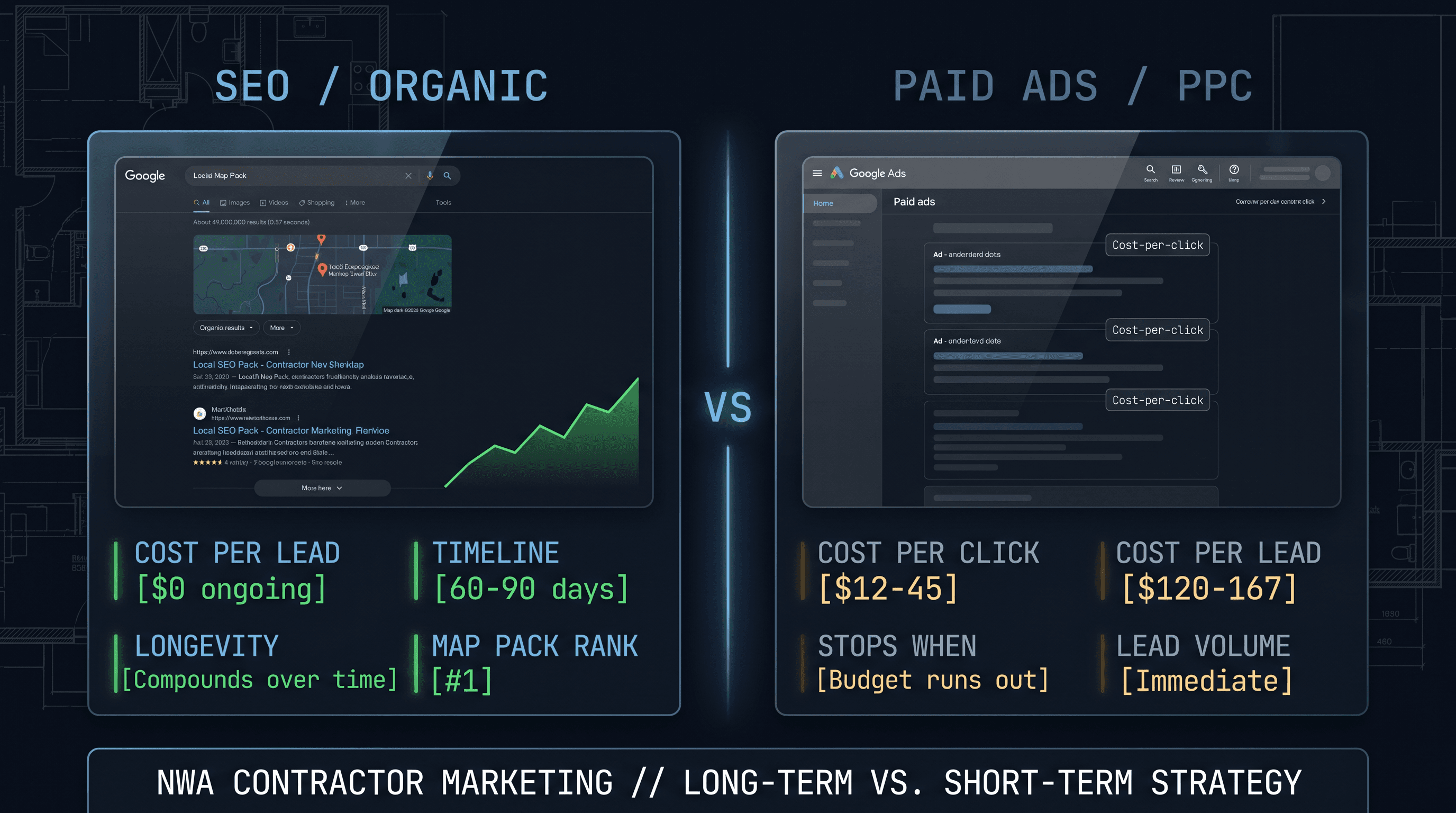
Local SEO vs. Paid Ads for Contractors: Which One Actually Makes Sense
Both can get your phone ringing. Here's how they actually work, what they cost, and which one makes more sense for where you are right now.

Contractors ask me this constantly: "Should I be running Google Ads or doing SEO?"
The honest answer is that they do different things, work on different timelines, and cost money in different ways. Neither one is always the right answer. The right choice depends on where you are right now — how established your business is, how much cash you have to work with, and how patient you can be.
Here's how both actually work, without the sales pitch on either side.
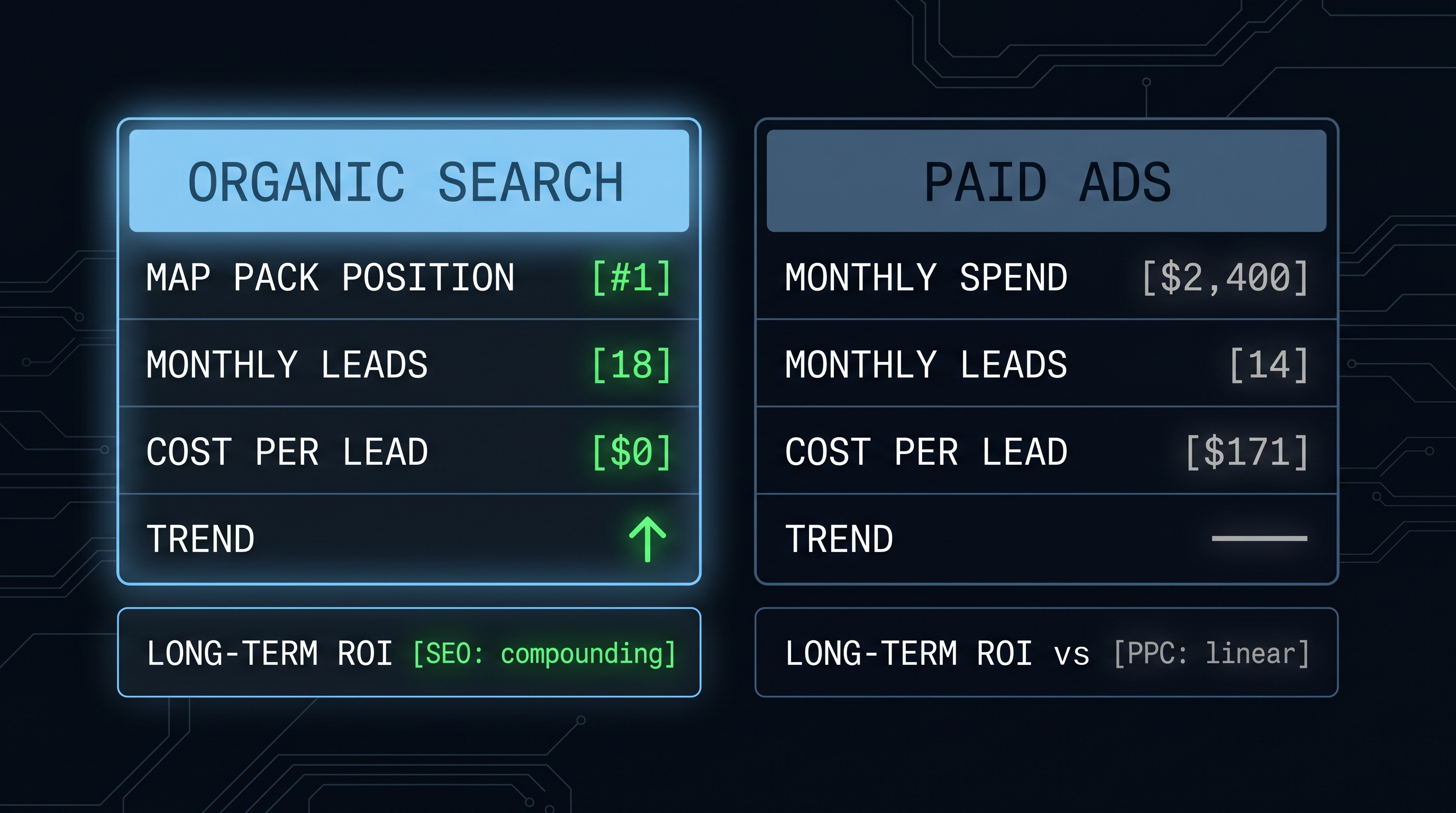
AI-generated: Side-by-side comparison of Local SEO and Paid Ads performance metrics for NWA contractors.
How Paid Ads Work for Contractors
Google gives contractors two main paid options. If you're not yet clear on how the Map Pack works and why it matters, this breakdown of how to get into the Google Map Pack is worth reading first.
Google Local Service Ads (LSAs) — These are the "Google Guaranteed" listings that appear at the very top of search results, above everything else. You pay per lead — a verified phone call or message — rather than per click. You go through a background check and license verification to qualify. Cost per lead varies by trade and market, but for NWA contractors you're typically looking at $20–$100+ per lead depending on the trade.
Google Ads (Search) — Standard pay-per-click ads. You bid on keywords, your ad appears when someone searches for them, and you pay each time someone clicks. For HVAC, plumbing, electrical, and roofing terms in NWA, cost per click typically runs $12–$45+. You need a website for these — the click goes somewhere, and if your site doesn't convert, you're paying for traffic that calls your competitor.
What paid ads do well:
- Start producing calls within days of launching
- Let you control exactly which searches trigger your ads
- Give you predictable, measurable lead volume tied to spend
- Fill pipeline gaps immediately when you need work
What paid ads don't do:
- Build anything that lasts. Stop paying, stop appearing. No exceptions.
- Get cheaper over time. Competition in NWA contractor markets has pushed CPCs up steadily.
- Replace the trust signals that come from reviews and organic rankings. Many homeowners skip ads entirely and scroll to organic results.
How Local SEO Works for Contractors
Local SEO is the work you do to show up in Google's Map Pack and organic results without paying per click. The complete local SEO guide for contractors goes deeper on every component if you want the full picture.
The Map Pack — the three businesses that appear with a map when someone searches "plumber Rogers AR" — is driven primarily by your Google Business Profile. It's influenced by how complete your profile is, how many reviews you have and how recent they are, whether your business information is consistent across the web, and how close you are to the person searching.
Organic results — the blue links below the Map Pack — are driven by your website. Pages that clearly describe your services, name your service cities, and answer the questions your customers are actually searching get indexed and ranked.
What local SEO does well:
- Builds rankings that generate calls at no cost per click once established
- Creates compounding returns — a ranking earned in month three is still working in year three
- Captures homeowners who skip paid ads and scroll to organic results
- Builds trust through reviews and content that converts before the first call
- Works across multiple search queries at once — one set of optimizations helps you rank for dozens of related searches
What local SEO doesn't do:
- Produce calls immediately. You're typically looking at 60–90 days for Map Pack movement, 3–6 months for meaningful organic traffic.
- Guarantee a specific call volume. Rankings fluctuate. Competitors improve. Algorithm updates happen.
- Work without ongoing attention. GBP needs photos and posts. Reviews need to keep coming in. Content needs to stay current.
The Real Cost Comparison
Let's put some numbers to it. These are estimates based on typical NWA contractor markets — your actual numbers will vary.
Paid ads scenario (HVAC, Rogers AR):
- Monthly ad budget: $1,500
- Average CPC for HVAC terms: $25
- Clicks per month: 60
- Call conversion rate from clicks: 15%
- Calls per month: 9
- Effective cost per call: ~$167
Local SEO scenario (HVAC, Rogers AR) — after 6 months:
- Monthly SEO cost: $500–$700 (professional management) or your own time
- Map Pack impressions from Map Pack position: varies widely
- Calls from organic/Map Pack: 10–25+/month once ranked (depending on position)
- Effective cost per call: Approaches zero as time goes on
The key difference: ads stop the moment you stop paying. SEO rankings persist and compound.
A contractor who spends $6,000 on ads over six months has nothing durable to show for it when they stop. A contractor who spends that same time and money building SEO has rankings that generate calls for years.
That said — you can't wait six months to fill your schedule. If you need work now, ads have a real role to play.
When to Use Ads
Use paid ads when:
- You're launching a new business and need calls before SEO has time to build
- You've hit a slow season and need to fill pipeline immediately
- You're expanding into a new service area and want fast coverage
- You've got the budget and want to dominate both paid and organic simultaneously
Local Service Ads (LSAs) are often the better starting point for contractors new to paid advertising. The pay-per-lead model is more predictable than pay-per-click, the "Google Guaranteed" badge adds trust, and you're not paying for window shoppers who click and bounce — only verified leads.
When to Prioritize SEO
Prioritize SEO when:
- You've been in business for more than a year and have satisfied customers who could leave reviews
- You want calls that don't cost you money per click
- You're thinking about where your business is in two to three years, not just this month
- You're tired of watching your ad budget disappear without building anything lasting
- You've been burned by an agency that promised results and didn't deliver
SEO is also the right choice if you're the kind of contractor who doesn't want to compete on price — organic rankings attract homeowners who are researching, reading, and comparing, which means they're more likely to value quality over lowest bid.
The Most Common Mistake
Contractors often treat ads and SEO as an either/or decision. The ones who grow fastest treat them as a sequence:
- Month 1–3: Run LSAs for immediate call volume. Simultaneously start SEO — optimize GBP, launch review generation, fix citations.
- Month 3–6: SEO starts producing Map Pack appearances. Reduce ad spend slightly as organic traffic builds. Keep review generation running.
- Month 6–12: Strong organic rankings established. Ad spend reduced to supplemental coverage on high-value terms. SEO carrying the base volume.
- Year 2+: Organic rankings are compounding. Ad budget is a fraction of what it was. Cost per lead from organic is effectively zero.
This approach uses ads to bridge the timeline gap while SEO builds something durable underneath.
What This Looks Like for NWA Contractors
In most NWA contractor markets — HVAC in Rogers, plumbing in Bentonville, roofing in Fayetteville — the Map Pack competition is real but not insurmountable. The businesses at the top got there because they started before you did, not because they have some advantage you can't match.
The gap closes with consistent execution: GBP optimized, reviews coming in monthly, citations consistent, website with real service pages.
If you want to know exactly where you stand right now and what the clearest path to the Map Pack looks like for your trade and city, run the free audit below or give me a call.
Or call directly: (479) 380-8626. No sales pitch — just an honest conversation about what's realistic for your situation.

Written by
Chad Smith
Founder of Local Search Ally. Helping NWA contractors get found on Google. Based in Siloam Springs, AR.